FAGATTA
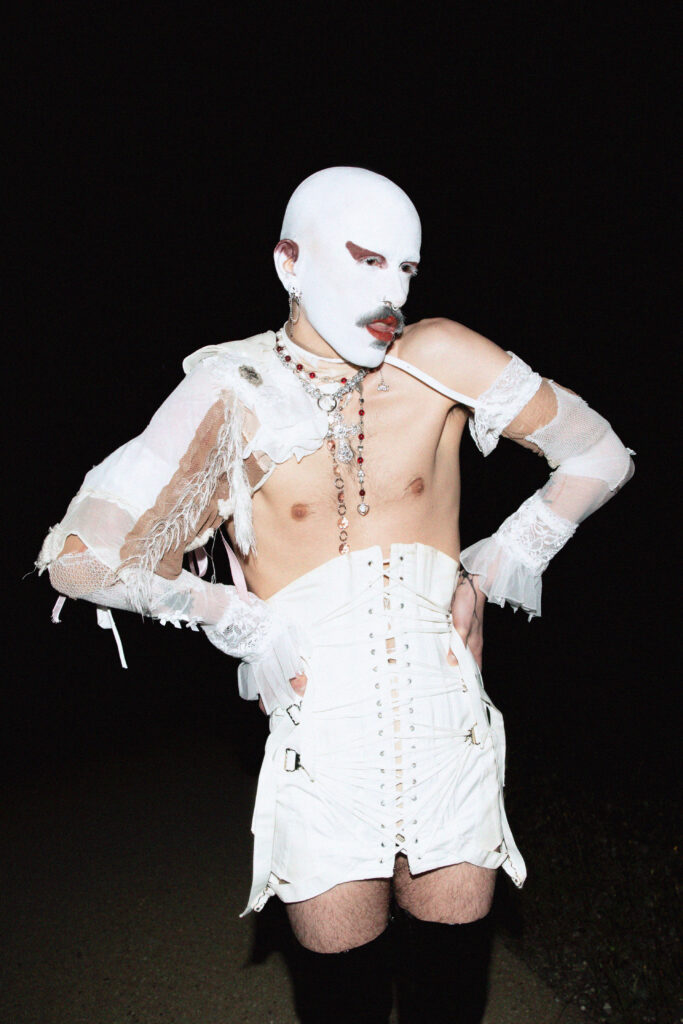
How is your personal approach to the discipline of drag performance and clowning?
What do u like about it?
My approach to drag performance is grounded in discipline, ritual, and transformation. I don’t see drag as something spontaneous or decorative, but as a constructed body of knowledge: concept, backstory, sound, movement, makeup, costume, and atmosphere all have to speak to each other. Every performance starts from an inner question or wound, and then I build a character that can carry it. In that sense, drag for me is closer to a practice than a genre, something I train, research, and refine. What I love about drag is its ability to hold contradiction. It allows me to be grotesque and divine, erotic and tragic, ridiculous and dangerous at the same time. I’m especially drawn to intensity, darkness, and excess, not to shock, but to create immersion. Drag gives me a language to externalize things that don’t fit neatly into everyday social behavior: fear, desire, shame, rage, myth.
How did u start to do it?
I started doing drag about three years ago, initially as a survival strategy. As a queer refugee, my body already existed in a constant state of translation and exposure. Drag became a way to reclaim control over how I am seen , to exaggerate it, distort it, weaponize it. Over time, it became more intentional and conceptual, moving from nightlife expression toward performance as a total artwork. Performing in different cities shaped this evolution, especially spaces that allowed experimentation rather than polish. f u perform drag, are you a drag king or a drag queen or something inbetween ? I don’t identify strictly as a drag queen or a drag king. My drag lives in between and beyond those categories. I’m interested in mutation rather than imitation. Sometimes my characters are hyper-feminine, sometimes monstrous, sometimes unreadable. Gender in my drag is never stable. It fractures, multiplies, collapses, and reappears in new forms.
Do u feel like multiplying gender through your drag/clown performance? If yes, why and
how?
Yes, I do feel that my drag multiplies gender. I’m not trying to “represent” genders but to proliferate them. Through layering: voiceovers, sound design, makeup that alters facial architecture, bodies that feel artificial or mythic, I create figures that feel like composites rather than identities. This multiplication is important to me because it resists the demand to be legible. It allows me to exist without explaining myself.
Is it possible for you to think Drag and Clown together? Do u see similarities,
contradictions and potential?
Thinking drag and clown together feels very natural to me. Both operate through exaggeration, failure, excess, and exposure. The clown reveals the constructed nature of social norms by embodying them badly or too much. Drag does something similar with gender, sexuality, power, and desire. Where they meet, I see huge potential: the tragic clown, the erotic fool, the monster who makes you laugh and then makes you uncomfortable. There are also contradictions. Clowning often leans toward vulnerability and openness, while drag can lean toward armor, glamour, and control. But I’m interested in that tension. I like when the armor cracks, when the figure loses control, when humor slips into discomfort. That’s where something honest happens.
What is for you the political of drag and/or clown?
For me, the political dimension of drag and clowning lies in visibility and refusal. Refusal to be normal, refusal to be quiet, refusal to be easily consumed. As a queer migrant body on stage, my presence is already political, but the politics deepen when I choose distortion over assimilation. Drag allows me to stage power differently, to mock authority, to eroticize what is usually marginalized, to turn shame into spectacle.
Do you connect this practice to humor?
I do connect this practice to humor, but not in a comforting way. The humor I’m interested in is cruel, awkward, excessive — the kind that makes people laugh and then question why they laughed. Humor becomes a tool to disarm, to seduce, and then to confront. In that sense, humor is not the opposite of seriousness; it’s a method of attack. My drag lives somewhere between ritual, clown, monster, and confession.