ZOE GUDOWICH a.k.a Zed Zeldich Zed
I work with Drag King performance as a tool to explore masculinity as a social fiction rather than a natural truth.
Through my character Zed Zeldich Zed, I use irony, vulnerability and humor to challenge patriarchal structures while creating spaces of collective play and transformation. My practice
combines performance, workshops, lecture-performances and installations — always centered on the body as a political archive where gender can be rewritten, multiplied and liberated.
Drag is not disguise for me — it is exposure.
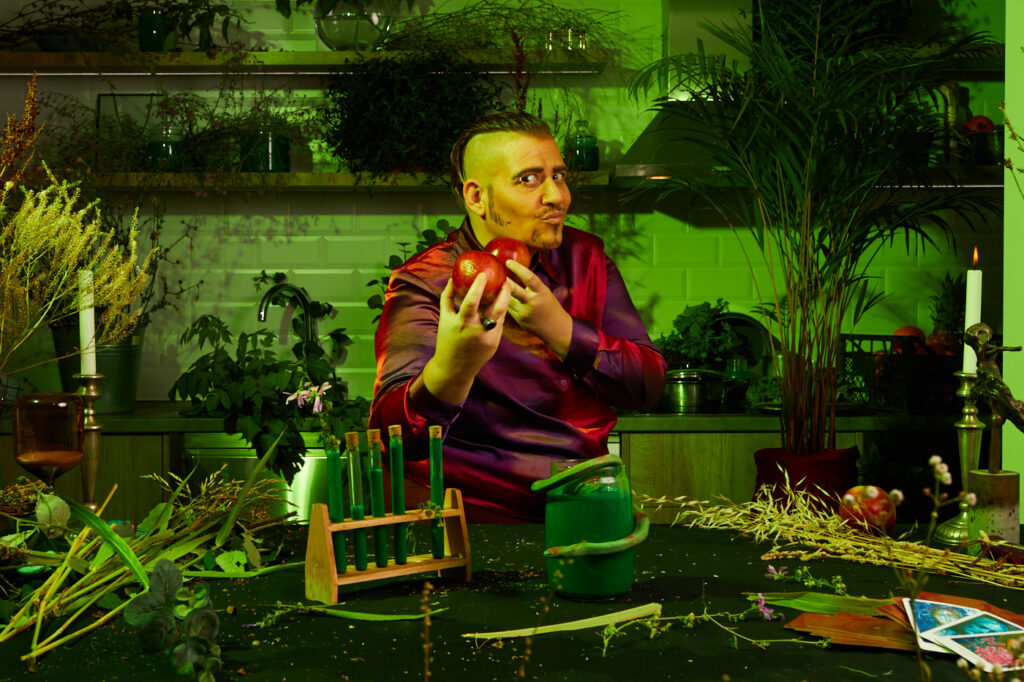
Your personal approach to drag performance & relation to clowning
My primary artistic practice is Drag King performance. I come from theatre, feminist activism and community-based art in Belgrade, where performance was always a collective tool for visibility, resistance and storytelling. Drag became the space where my interests in body work, voice, humor and political critique naturally met. Through my character Zed Zeldich Zed, I explore masculinity as a social performance — how it is constructed, rehearsed, exaggerated and destabilized on stage. My work uses parody, vulnerability and tenderness as political strategies: instead of attacking power directly, I expose how fragile and absurd it actually is. Clowning is not my discipline, but I connect to it conceptually. I see drag and clown as neighboring artistic territories. Both work through exaggeration, humor, failure and vulnerability. While clown often focuses on the fragility of the human ego, drag exposes the fragility and performativity of gender roles. I meet clown at that intersection of humor and exposure — though my artistic language remains rooted in Drag King performance.
Are you a Drag King or a Drag Queen?
I perform as a Drag King.
My alter ego is Zed Zeldich Zed, a hybrid character created over 20 years ago in the Balkans — one of the earliest visible Drag King personas from that region. Zed plays with macho archetypes, emotional bravado and seductive masculinity. He appears simultaneously confident and ridiculous, erotic and vulnerable — never a heroic figure, but masculinity in its full emotional exposure.
Do you multiply gender through your drag performance?
How and why?
Yes — that is the core of my work.
Drag does not “switch” gender — it multiplies it.
On stage I don’t become a man; I present many masculinities at once:
- masculinity as parody
- masculinity as desire
- masculinity as vulnerability
- masculinity as tenderness
Through these layers, gender becomes fluid, playful and performative rather than fixed or oppressive. Gender is revealed as a costume — and costumes can change.
Can Drag and Clown be connected? Similarities and contradictions?
Yes — they share important tools.
Both Drag and Clown use:
- exaggeration and absurdity
- failure as creative force
- identity as a mask
- humor as a critical weapon
Clown disarms the ego; drag disarms gender norms.
In both practices, performance reveals that all identities are already staged — which is why they can also be reimagined.
They meet perfectly at the point where humor becomes political.
The political aspect of Drag and Clown
Drag is political because it:
- challenges binary gender systems
- makes queer bodies and desires visible
- transforms pleasure into resistance
By performing masculinity “too well,” Zed paradoxically destroys it from inside — exposing
patriarchy as theatrical fiction rather than natural law.
Clown is political because it:
- celebrates vulnerability instead of success
- undermines authority through failure
- values empathy over discipline
Both practices resist capitalist systems that glorify productivity, perfection and obedience by
honoring joy, absurdity and emotional presence.
Humor and politics
Humor is my strongest political strategy.
Anger confronts power —
but laughter unstabilizes it.
Through humor:
- fear softens
- bodies open
- dialogue begins
Drag humor is not escapism — it is a survival skill.
It allows political ideas to be felt with the body, not only understood with the mind.
About Zed Zeldich Zed
Zed Zeldich Zed is the first Drag King figure from the Balkans, emerging in 2003 as part of feminist and queer underground scenes. Since then, Zed has been traveling through stages, galleries, classrooms, workshops — and sometimes people’s dreams.
Zed’s voice “moves mountains,” and his physical presence always claims the center of the stage. His performance style combines exaggerated masculinity with tenderness and poetic absurdity.
He openly defies all systems of domination — especially patriarchy and capitalism, which suffocate bodies and desires alike. Zed is a passionate communist: he believes in social justice, collective liberation and solidarity as everyday practice. His struggle is a class struggle expressed through drag performance.
Currently, Zed lives and works in Vienna, continuing to operate at the intersection of art, activism and education through workshops inspired by Drag King pioneer Diane Torr, as well as performances, lectures and interdisciplinary collaborations.
@zedzeldichzed
Final reflection
For me, drag is not costume — it is revelation.
It takes fear and turns it into play.
It turns rigidity into movement.
It turns silence into voice.
Drag allows us to imagine:
new genders,
new relations,
new communities.
And most importantly:
Joy itself becomes resistance.