NORA JACOBS
“Failure is at the center of my work. Although capitalism considers it negative, I believe it has the power to bring about (positive) change: in form of self-empowerment and places filled with possibilities. All there to make space for queer utopias. In the fight against patriarchy, social norms, and binary systems for a queer future à la glitch.”
How is your personal approach to the discipline of drag performance and clowning? What do u like about it? How did u start to do it?
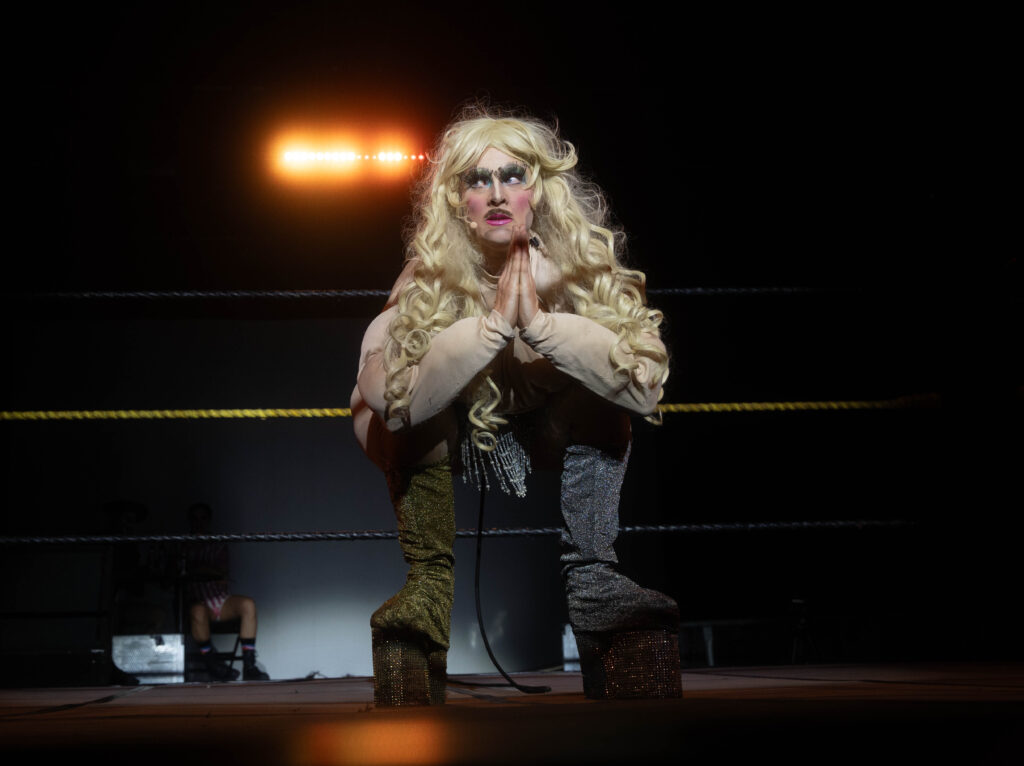
I come from Theatre, Visual Arts and Circus. I don’t have alter egos such as drag personas but I do have several different types of characters that serve me depending on what I want to convey. However, my first Drag character was possibly, unintentionally a bride looking for her husband to be. I was 21 and still at Circus school. I had no clue about drag. The husband was always someone from the audience, who then had to endure my wedding ceremony. Nowadays I probably would have performed the husband or the bride would have looked for several brides to be or… My first Drag King character was Ilya Afanasyevich Shamrayev from the play The Seagull by Anton Chekhov. I was in acting school and still did not understand that this could be a thing. A couple of years later Dick emerged. He was the lead in a performance of the same name by Bernadette Anzengruber. For this, I took part in my first drag workshop, which was led by Diane Torr. Thank you, Diane. I was not very self-confident at the time and needed someone to give me that little kick to get started. Afterwards I finally had the courage to start creating my own drag characters. They are called Johnny or Cowboy Cowdy or STARLET. However, I still perform for other people’s theatre productions. For example, WIRECARD – Last Exit Bad Vöslau by Marie Christin Rissinger where I played Richard Alexander Fuhrmann. I like dressing up to surprise, empower, make people laugh and think at the same time. Humour is an important aspect. It’s that moment when the mouth is wide open and you place your message right in middle of that mouth to add something to chew on. I like that.
If u perform drag, are you a drag king or a drag queen?
Sometimes I perform as a Drag King. Sometimes I perform as a Drag Queen. And sometimes I am neither nor. I like to challenge societies norms and the binary gender system. For example, STARLET used to be a cis woman, myself, playing a man, who dresses up as a drag queen. However, nowadays STARLET is far more in-between, an entity on their own and not so straight anymore.
Do u feel like multiplying gender through your drag/clown performance?
If yes, why and how?
Instead of repeating all the toxic masculinities out there, I try to find new ways of being and existing in this world. Exaggeration is definitely a big part of my performances to help me make bold statements. With my drag I try to empower my audience.
Is it possible for you to think Drag and Clown together?
Do u see similarities, contradictions and potential?
For me drag and clown go hand in hand although this isn’t true for everyone. Making fun of yourself and not others is a good way to start.
What is for you the political of drag and/or clown?
Do you connect this practice to humour?
Humour is always political. Women were in a long run not seen as funny at all but hey why are women* so funny?! (For one performative answer check out “Running Gag” by Sööt/Zeyringer) As long as Drag Story Hours or Drag Storytime (where Drag Personas read children books to children) get negative press, drag is political.